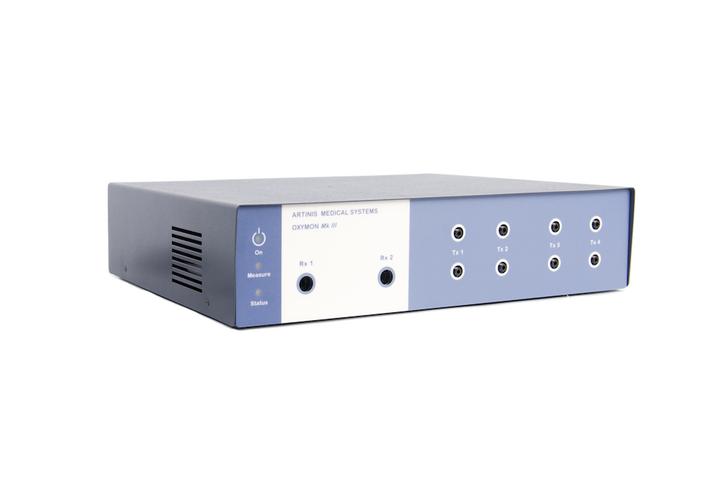
Publications using the OxyMon
Effect of ventilation on cerebral oxygenation during exercise: Insights from canonical correlation
We tested hypothesis that cerebral deoxygenation near maximal exercise intensity is mediated by hyperventilation, via hypocapnia-induced reductions in cerebral blood flow, by utilizing canonical correlation analysis (CCA) to determine the relative …
Energy metabolism in human calf muscle performing isometric plantar flexion superimposed by 20-Hz vibration
Vibration training is commonly expected to induce an active muscle contraction via a complex reflex mechanism. In calf muscles of 20 untrained subjects, the additional energy consumption in response to vibration superimposed on an isometric …
Low-level activity of the trunk extensor muscles causes electromyographic manifestations of fatigue in absence of decreased oxygenation
This study was designed to determine whether trunk extensor fatigue occurs during low-level activity and whether this is associated with a drop in muscle tissue oxygenation. Electromyography (EMG) feedback was used to impose constant activity in a …
NIRS-SPM: Statistical parametric mapping for near-infrared spectroscopy
Near infrared spectroscopy (NIRS) is a non-invasive method to measure brain activity via changes in the degree of hemoglobin oxygenation through the intact skull. As optically measured hemoglobin signals strongly correlate with BOLD signals, …
No impaired hemoglobin oxygenation in forearm muscles of patients with chronic CRPS-1
OBJECTIVES: Physiotherapy is considered an important treatment option in patients with upper limb complex regional pain syndrome type-1 (CRPS-1). In case of chronic CRPS-1, exercise therapy of the affected limb forms an important part of the …
Wavelet minimum description length detrending for near-infrared spectroscopy
Near-infrared spectroscopy (NIRS) can be employed to investigate brain activities associated with regional changes of the oxy- and deoxyhemoglobin concentration by measuring the absorption of near-infrared light through the intact skull. NIRS is …
General linear model and inference for near infrared spectroscopy using global confidence region analysis
Near infared spectroscopy (NIRS) is a non-invasive method to measure the brain activity as the changes of hemoglobin oxygenation through the intact skull. In this paper, we statistically analyze the NIRS data based on general linear model (GLM) and …
A transvaginal probe for near infrared spectroscopic monitoring of the bladder detrusor muscle and urethral sphincter
The majority of in vivo applications of near infrared spectroscopic (NIRS) monitoring use transcutaneous optode placement over the tissue of interest. Invasive application of optodes is occasionally described for monitoring tissue too deep for …
Cerebrovascular responses to incremental exercise during hypobaric hypoxia: Effect of oxygenation on maximal performance
We sought to describe cerebrovascular responses to incremental exercise and test the hypothesis that changes in cerebral oxygenation influence maximal performance. Eleven men cycled in three conditions: 1) sea level (SL); 2) acute hypoxia [AH; …
Knee angle-dependent oxygen consumption of human quadriceps muscles during maximal voluntary and electrically evoked contractions
Fatigability and muscle oxygen consumption (mVO2) during sustained voluntary isometric knee extensions are less at extended (30° knee angle; 07deg;, full extension) versus flexed knee angles (907deg;). This lower energy consumption may partially …
Near-infrared spectroscopy extended with indocyanine green dye dilution for cerebral blood flow measurement: Median values in healthy volunteers
The cerebral blood flow (CBF) is an important vital parameter in neurointensive care. Currently, there is no non-invasive method for its measurement that can easily be applied at the bedside. A new tool to determine CBF is based on near-infrared …
Saturation of hemoglobin in intracranial arteries is similar in patients with hemodynamically relevant and irrelevant stenosis of the internal carotid artery
The aim of this study was to establish if patients with hemodynamically relevant or irrelevant stenoses of the extracranial internal carotid artery have different intracranial arterial oxygen saturation as measured by transcranial pulse oximetry …
Cerebral hemodynamics and oxygenation after serial CSF drainage in infants with PHVD
The aim of our study was to assess consecutive changes in cerebral oxygenation and hemodynamics after serial cerebrospinal fluid (CSF) drainage from a subcutaneous ventricular catheter reservoir (SVCR) in infants with PHVD. Infants with PHVD were …
Effect of short recovery intensities on the performance during two Wingate tests
PURPOSE: To assess the effects of the intensity of short recoveries on performance by a Wingate test and on the deoxyhemoglobin variations. METHODS: Twelve male subjects performed a graded test and three sessions of repeated all-out tests with …
Effects of acute hypoxia on cerebral and muscle oxygenation during incremental exercise
To determine if fatigue at maximal aerobic power output was associated with a critical decrease in cerebral oxygenation, 13 male cyclists performed incremental maximal exercise tests (25 W/min ramp) under normoxic (Norm: 21% FIO2) and acute hypoxic …
Severity of arterial hypoxaemia affects the relative contributions of peripheral muscle fatigue to exercise performance in healthy humans
We examined the effects of hypoxia severity on peripheral versus central determinants of exercise performance. Eight cyclists performed constant-load exercise to exhaustion at various fractions of inspired O2 fraction (FIO2 0.21/0.15/0.10). At task …
The isometric torque at which knee-extensor muscle reoxygenation stops
PURPOSE: We investigated the knee-extensor torque at which reoxygenation (inflow of arterial blood) during an isometric contraction stopped, whether this torque depended on maximal torque capacity (MTC), and whether there were differences among the …
Knee extensor muscle oxygen consumption in relation to muscle activation
Recently, fatigability and muscle oxygen consumption (mVO2) during sustained isometric contractions were found to be less at shorter (30° knee angle; 0° = full extension) compared to longer knee extensor muscle lengths (90°) and, at low torques, less …
Forearm blood flow and oxygen consumption in patients with bilateral repetitive strain injury measured by near-infrared spectroscopy
Despite the social impact of repetitive strain injury (RSI), little is known about its pathophysiological mechanism. The main objective of this study was to assess the local muscle oxygenation (mVO2) and blood flow (mBF) of the forearm in individuals …
Cerebral oxygen supply during hypotension in near-term lambs: A near-infrared spectroscopy study
Sufficient O2-supply to the brain is necessary for an adequate cerebral energy metabolism, function and growth. To elucidate the relation between changes in, respectively, mean arterial blood pressure (MABP) and cerebral O2-supply and changes in the …