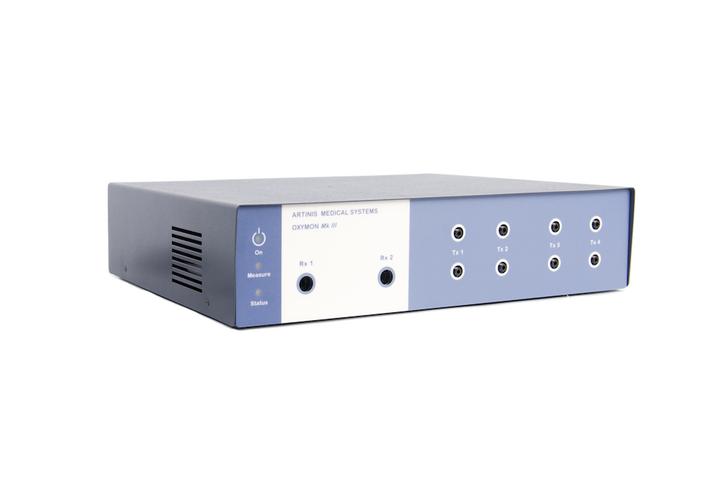
Publications using the OxyMon
The effect of elbow angle and external moment on load sharing of elbow muscles
To study elbow muscle load sharing we investigated the effect of external flexion-extension (FE) and pronation-supination (PS) moments and elbow angle on muscle activation and oxygen consumption (V̇O2).Two data sets were obtained. First, (n=6) …
Effect of bladderbox alarms during venoarterial extracorporeal membrane oxygenation on cerebral oxygenation and hemodynamics in lambs
To determine the effects of bladderbox alarms during venoarterial extracorporeal membrane oxygenation (va-ECMO) on cerebral oxygenation and hemodynamics, six lambs were prospectively treated with va-ECMO and bladderbox alarms were simulated. Changes …
A Dynamic Objective Evaluation of Peripheral Arterial Disease by Near-Infrared Spectroscopy
Objectives: Near-Infrared Spectroscopy (NIRS), suitable for dynamic measurements, is not routinely used for peripheral arterial disease (PAD). We propose a dynamic NIRS-based measurement to quantify variations in muscle metabolism in PAD. Method: …
Cerebrovascular reserve capacity is impaired in patients with sickle cell disease
Sickle cell disease (SCD) is associated with a high incidence of ischemic stroke. SCD is characterized by hemolytic anemia, resulting in reduced nitric oxide-bioavailability, and by impaired cerebrovascular hemodynamics. Cerebrovascular CO2 …
Emotional modulation of visual cortex activity: A functional near-infrared spectroscopy study
Functional neuroimaging and electroencephalography reveal emotional effects in the early visual cortex. Here, we used functional near-infrared spectroscopy to examine haemodynamic responses evoked by neutral, positive and negative emotional pictures, …
Changes in cerebral oxygenation and hemodynamics during cranial ultrasound in preterm infants
Objectives: To evaluate whether application of a transducer on the anterior fontanelle during cranial ultrasound (US) examination effects cerebral hemodynamics and oxygenation in preterm infants. Study design*: During cranial US examination, changes …
Frontal and motor cortex oxygenation during maximal exercise in normoxia and hypoxia
Reductions in prefrontal oxygenation near maximal exertion may limit exercise performance by impairing executive functions that influence the decision to stop exercising; however, whether deoxygenation also occurs in motor regions that more directly …
A method to calculate arterial and venous saturation from near infrared spectroscopy (NIRS)
For adequate development and functioning of the neonatal brain, sufficient oxygen (O2) should be available. With a fast sampling (fs 50 Hz) continuous wave NIRS device, arterial (SaO2) and venous (SvO2) saturation can be measured using the …
Dynamic topographic mapping of the human bladder during voiding using functional near-infrared spectroscopy
Functional near-infrared spectroscopy (fNIRS) with multichannel instruments and grids of source-detector pairs can map regional change in oxygenation/hemodynamics. Developed for cortical brain mapping, fNIRS technology has relevance in other organs …
Effect of ventilation on cerebral oxygenation during exercise: Insights from canonical correlation
We tested hypothesis that cerebral deoxygenation near maximal exercise intensity is mediated by hyperventilation, via hypocapnia-induced reductions in cerebral blood flow, by utilizing canonical correlation analysis (CCA) to determine the relative …
Energy metabolism in human calf muscle performing isometric plantar flexion superimposed by 20-Hz vibration
Vibration training is commonly expected to induce an active muscle contraction via a complex reflex mechanism. In calf muscles of 20 untrained subjects, the additional energy consumption in response to vibration superimposed on an isometric …
Low-level activity of the trunk extensor muscles causes electromyographic manifestations of fatigue in absence of decreased oxygenation
This study was designed to determine whether trunk extensor fatigue occurs during low-level activity and whether this is associated with a drop in muscle tissue oxygenation. Electromyography (EMG) feedback was used to impose constant activity in a …
NIRS-SPM: Statistical parametric mapping for near-infrared spectroscopy
Near infrared spectroscopy (NIRS) is a non-invasive method to measure brain activity via changes in the degree of hemoglobin oxygenation through the intact skull. As optically measured hemoglobin signals strongly correlate with BOLD signals, …
No impaired hemoglobin oxygenation in forearm muscles of patients with chronic CRPS-1
OBJECTIVES: Physiotherapy is considered an important treatment option in patients with upper limb complex regional pain syndrome type-1 (CRPS-1). In case of chronic CRPS-1, exercise therapy of the affected limb forms an important part of the …
Wavelet minimum description length detrending for near-infrared spectroscopy
Near-infrared spectroscopy (NIRS) can be employed to investigate brain activities associated with regional changes of the oxy- and deoxyhemoglobin concentration by measuring the absorption of near-infrared light through the intact skull. NIRS is …
General linear model and inference for near infrared spectroscopy using global confidence region analysis
Near infared spectroscopy (NIRS) is a non-invasive method to measure the brain activity as the changes of hemoglobin oxygenation through the intact skull. In this paper, we statistically analyze the NIRS data based on general linear model (GLM) and …
A transvaginal probe for near infrared spectroscopic monitoring of the bladder detrusor muscle and urethral sphincter
The majority of in vivo applications of near infrared spectroscopic (NIRS) monitoring use transcutaneous optode placement over the tissue of interest. Invasive application of optodes is occasionally described for monitoring tissue too deep for …
Cerebrovascular responses to incremental exercise during hypobaric hypoxia: Effect of oxygenation on maximal performance
We sought to describe cerebrovascular responses to incremental exercise and test the hypothesis that changes in cerebral oxygenation influence maximal performance. Eleven men cycled in three conditions: 1) sea level (SL); 2) acute hypoxia [AH; …
Knee angle-dependent oxygen consumption of human quadriceps muscles during maximal voluntary and electrically evoked contractions
Fatigability and muscle oxygen consumption (mVO2) during sustained voluntary isometric knee extensions are less at extended (30° knee angle; 07deg;, full extension) versus flexed knee angles (907deg;). This lower energy consumption may partially …
Near-infrared spectroscopy extended with indocyanine green dye dilution for cerebral blood flow measurement: Median values in healthy volunteers
The cerebral blood flow (CBF) is an important vital parameter in neurointensive care. Currently, there is no non-invasive method for its measurement that can easily be applied at the bedside. A new tool to determine CBF is based on near-infrared …