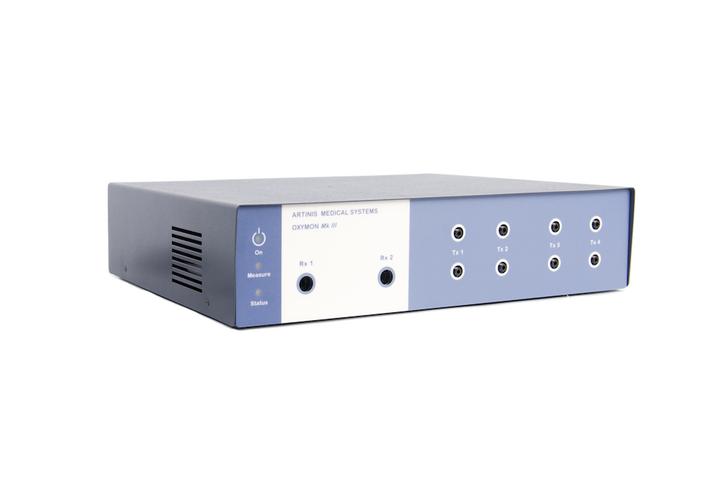
Publications using the OxyMon
Saturation of hemoglobin in intracranial arteries is similar in patients with hemodynamically relevant and irrelevant stenosis of the internal carotid artery
The aim of this study was to establish if patients with hemodynamically relevant or irrelevant stenoses of the extracranial internal carotid artery have different intracranial arterial oxygen saturation as measured by transcranial pulse oximetry …
Cerebral hemodynamics and oxygenation after serial CSF drainage in infants with PHVD
The aim of our study was to assess consecutive changes in cerebral oxygenation and hemodynamics after serial cerebrospinal fluid (CSF) drainage from a subcutaneous ventricular catheter reservoir (SVCR) in infants with PHVD. Infants with PHVD were …
Effect of short recovery intensities on the performance during two Wingate tests
PURPOSE: To assess the effects of the intensity of short recoveries on performance by a Wingate test and on the deoxyhemoglobin variations. METHODS: Twelve male subjects performed a graded test and three sessions of repeated all-out tests with …
Effects of acute hypoxia on cerebral and muscle oxygenation during incremental exercise
To determine if fatigue at maximal aerobic power output was associated with a critical decrease in cerebral oxygenation, 13 male cyclists performed incremental maximal exercise tests (25 W/min ramp) under normoxic (Norm: 21% FIO2) and acute hypoxic …
Severity of arterial hypoxaemia affects the relative contributions of peripheral muscle fatigue to exercise performance in healthy humans
We examined the effects of hypoxia severity on peripheral versus central determinants of exercise performance. Eight cyclists performed constant-load exercise to exhaustion at various fractions of inspired O2 fraction (FIO2 0.21/0.15/0.10). At task …
The isometric torque at which knee-extensor muscle reoxygenation stops
PURPOSE: We investigated the knee-extensor torque at which reoxygenation (inflow of arterial blood) during an isometric contraction stopped, whether this torque depended on maximal torque capacity (MTC), and whether there were differences among the …
Knee extensor muscle oxygen consumption in relation to muscle activation
Recently, fatigability and muscle oxygen consumption (mVO2) during sustained isometric contractions were found to be less at shorter (30° knee angle; 0° = full extension) compared to longer knee extensor muscle lengths (90°) and, at low torques, less …
Forearm blood flow and oxygen consumption in patients with bilateral repetitive strain injury measured by near-infrared spectroscopy
Despite the social impact of repetitive strain injury (RSI), little is known about its pathophysiological mechanism. The main objective of this study was to assess the local muscle oxygenation (mVO2) and blood flow (mBF) of the forearm in individuals …
Cerebral oxygen supply during hypotension in near-term lambs: A near-infrared spectroscopy study
Sufficient O2-supply to the brain is necessary for an adequate cerebral energy metabolism, function and growth. To elucidate the relation between changes in, respectively, mean arterial blood pressure (MABP) and cerebral O2-supply and changes in the …
Effects of midazolam and morphine on cerebral oxygenation and hemodynamics in ventilated premature infants
Background: Midazolam sedation and morphine analgesia are commonly used in ventilated premature infants. Objectives: To evaluate the effects of midazolam versus morphine infusion on cerebral oxygenation and hemodynamics in ventilated premature …
Effects of rapid versus slow infusion of sodium bicarbonate on cerebral hemodynamics and oxygenation in preterm infants
Background: Sodium bicarbonate (NaHCO3) is often used for correction of metabolic acidosis in preterm infants. The effects of NaHCO 3 administration on cerebral hemodynamics and oxygenation are not well known. Furthermore, there is no consensus on …
The relationship between two different mechanical cost functions and muscle oxygen consumption
Inverse-dynamic models often use cost functions to solve the load-sharing problem. Although it is often assumed that energy is minimised, most cost functions are based on mechanically related measures like muscle force or stress. The aim of this …
Back extensor muscle oxygenation and fatigability in healthy subjects and low back pain patients during dynamic back extension exertion
The purpose of this study was to assess if chronic low back pain patients have impaired paraspinal muscle O2 turnover and endurance capacity as compared to healthy control subjects during dynamic exercise. Middle-aged healthy male subjects (n = 12, …
Brain cell function during hypoxemia in near-term lambs: A near-infrared spectroscopy study
Background: Sufficient O2 supply to the brain is necessary for adequate cerebral energy metabolism, function and growth. Objectives: To elucidate the relation between changes in cerebral arterial O2 content and cerebral O2 supply and changes in the …
Effects of skin on bias and reproducibility of near-infrared spectroscopy measurement of cerebral oxygenation changes in porcine brain
The influence of skin on the bias and reproducibility of regional cerebral oxygenation measurements is investigated using cw near-infrared spectroscopy (NIRS). Receiving optodes are placed over the left and right hemispheres of a piglet (C3, C4 EEG …
Knee angle-dependent oxygen consumption during isometric contractions of the knee extensors determined with near-infrared spectroscopy
Fatigue resistance of knee extensor muscles is higher during voluntary isometric contractions at short compared with longer muscle lengths. In the present study we hypothesized that this would be due to lower energy consumption, at short muscle …
In vivo quantitative near-infrared spectroscopy in skeletal muscle and bone during rest and isometric exercise
The aim of this study was to investigate the performance of in vivo quantitative near- infrared spectroscopy (NIRS) in skeletal muscle at various workloads. NIRS was used for the quantitative measurement of O2 consumption (m _VO2) in the human flexor …
NIR spectroscopic measurement of local muscle metabolism during rhythmic, sustained, and intermittent handgrip exercise
The aim of this study was to investigate local muscle oxygen consumption (mVO2) during various protocols of isometric handgrip exercise. mVO2was measured by near-infrared spectroscopy (NIRS) during sustained, rhythmic, and intermittent isometric …
Noninvasive measurement of regional cerebral blood flow and regional cerebral blood volume by near-infrared spectroscopy and indocyanine green dye dilution
To find a suitable method for measuring regional cerebral blood flow (rCBF) rapidly at the bedside is still a matter of investigation. The purpose here was to develop a noninvasive method for bedside rCBF measurement and to validate it with a …