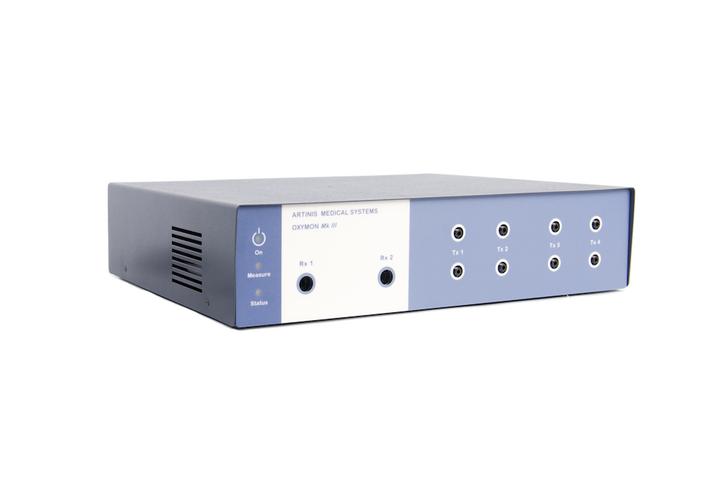
Publications using the OxyMon
Pitfalls in neonatal cardiac surgery using antegrade cerebral perfusion
In the past decade, advances in the surgical management of children with severe congenital heart disease (CHD) have led to a dramatic improvement in survival. The greatest impact of these advances has been on neonates with complex, and what …
Reproducibility of orthostatic changes in cerebral oxygenation in healthy subjects aged 70 years or older
In the elderly, standing can frequently be accompanied by blood pressure (BP) changes and cerebral symptoms such as dizziness, fall, or even syncope, but this may vary from day-to-day. Therefore, we aimed to investigate the reproducibility of …
Simultaneous near-infrared spectroscopy monitoring of left and right occipital areas reveals contra-lateral hemodynamic changes upon hemi-field paradigm
In this study we have shown that in humans it is possible to monitor non-invasively and simultaneously both hemispheres revealing cortical oxygenation changes in the occipital area in response to a contra-lateral hemi-field paradigm. A novel …
Ventilatory response in metabolic acidosis and cerebral blood volume in humans
The relationship between alterations in cerebral blood volume (CBV) and central chemosensitivity regulation was studied under neutral metabolic conditions and during metabolic acidosis. Fifteen healthy subjects (56±10 years) were investigated. To …
In vivo near-infrared spectroscopy
Interrogation of tissue with light offers the potential for noninvasive chemical measurement, and penetration with near-infrared wavelengths (750-1000 nm) is greater than with visible light. Specific absorption by clinically relevant compounds such …
Orthostatic tolerance, cerebral oxygenation, and blood velocity in humans with sympathetic failure
Background and Purpose - Patients with orthostatic hypotension due to sympathetic failure become symptomatic when standing, although their capability to maintain cerebral blood flow is reported to be preserved. We tested the hypothesis that in …
Cerebral oxygenation declines in healthy elderly subjects in response to assuming the upright position
Background and Purpose - With increasing age, assuming the upright position is more often accompanied by symptoms such as dizziness and lightheadedness, possibly as a result of a diminished oxygen supply to the brain due to impaired cerebral …
Human motor cortex oxygenation changes induced by cyclic coupled movements of hand and foot
Near-infrared spectroscopy (NIRS) was used to assess human motor-cortex oxygenation changes in response to cyclic coupled movements of hand and foot. Using a highly sensitive NIRS instrument, we showed that it was possible to detect reproducible …
Quantitative near-infrared spectroscopy discriminates between mitochondrial myopathies and normal muscle
Five patients with chronic progressive external ophthalmoplegia (CPEO) and 27 healthy controls were examined by near-infrared spectroscopy (NIRS) for the noninvasive and direct quantitative measurement of muscle oxygen consumption and forearm blood …
Muscle O2 consumption by NIRS: A theoretical model
In the past, the measurement of O2 consumption (Ȯ2) by the muscle could be carried out noninvasively by near-infrared spectroscopy from oxyhemoglobin and/or deoxyhemoglobin measurements only at rest or during steady isometric contractions. In the …
<title>New and highly sensitive continuous-wave near-infrared spectrophotometer with multiple detectors</title>
For a long time continuous wave near infrared instruments have been used to detect oxygenation changes in tissue. These instruments have proven to be reliable. The new generation of instruments, such as phase-modulated systems, or time-of-flight …
<title>Detailed evidence of cerebral hemoglobin oxygenation changes in response to motor cortical activation revealed by a continuous-wave spectrophotometer with 10-Hz temporal resolution</title>
In the last four years near infrared spectroscopy (NIRS) has been used in cerebral functional activation studies to monitor changes in concentration of oxy-, deoxy- and total hemoglobin ([O 2 Hb], [HHb] and [tHb] respectively) in response to …